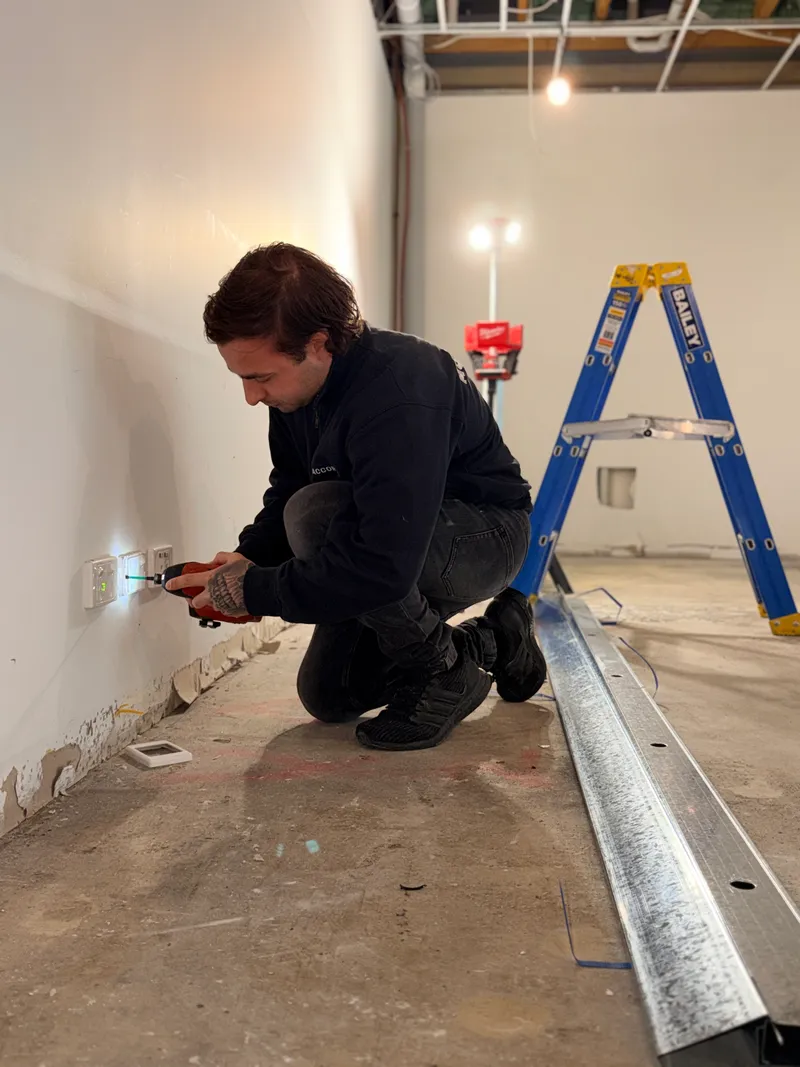
A neighbourhood retail centre: mandatory testing and essential services maintenance delivered across approximately 14 specialty tenancies.
Mandatory testing
Test & Tag Services in Melbourne (AS/NZS 3760)
Portable appliance testing for workplaces, tenancies and building portfolios: every appliance tested to AS/NZS 3760 on the correct interval for its environment, every result in a register you can hand to an auditor.
What test and tag covers, and who has to do it
Test and tag is the inspection and electrical testing of plug-in equipment: leads, power boards, tools, kitchen appliances, gym equipment, anything with a plug that people use at work. Under Victorian OHS duties an employer or building operator must be able to show that electrical equipment is safe to use, and AS/NZS 3760 is the recognised method of showing it.
The obligation lands in more places than people expect. An office tenancy, a cafe in a shopping centre, a gym in an apartment tower and the equipment in a building manager's store room all carry it. If your building or business has never held a testing register, that gap is invisible right up until an incident or an insurer asks for it.
Testing intervals are set by environment, not habit
AS/NZS 3760 does not prescribe one interval for everything. A lead on a construction site, an appliance in a commercial kitchen and a monitor in an office all sit in different environment classes with different retest intervals. Testing everything annually is the common default, and it is frequently wrong in both directions: over-testing benign equipment and under-testing hostile-environment equipment.
We classify the environment first, then build the schedule. Each item gets a durable tag with its test date and next due date, and the register keeps the whole population visible, including the items that failed and were removed.
Beyond the sticker: registers and records
The tag on the appliance is the smallest part of the job. What protects you in an audit is the register: what was tested, what passed, what failed and was withdrawn, and when the next cycle is due. Ours is maintained per site and per tenancy, and it slots into the same reporting stack as our RCD testing and Essential Safety Measures records, so a building's whole compliance position lives in one place.
One partner for every testing obligation
Most test and tag providers do only test and tag, which leaves you running separate contractors and separate calendars for appliance testing, RCD trip tests, exit and emergency lighting and switchboard inspection. We are a commercial electrical contractor first, so all of it lands in one scheduled visit cycle with one report pack, and anything a test finds can be repaired by the same team rather than referred on.
Portfolios and multi-site programs
We run testing across single tenancies, whole centres and multi-site portfolios. At a neighbourhood shopping centre in Epping that means mandatory testing across roughly 14 tenancies in one coordinated program; for a facilities manager it means one schedule and one register across every property on the books. If you manage more than one site, start with our facilities management electrical services.
Proven on site Epping Coburg Inner Melbourne
Recent works
Real scopes across Melbourne. Client names available on request.
A supermarket-anchored shopping centre: scheduled compliance testing alongside essential services, switchboard and lighting maintenance, seven days a week.
A private members' wellness club: routine testing of wellness equipment and RCDs across multiple venues.
- Registered Electrical Contractor (REC 36957)
- Comprehensive insurance across all works
- Qualified electricians with current certifications
- Proven across high-rise, commercial, industrial and retail
- Minimal-disruption delivery in occupied, live environments
Common questions
Frequently asked questions
Is test and tag legally required in Victoria?
Victorian OHS law requires employers and building operators to ensure electrical equipment is safe, and AS/NZS 3760 in-service testing is the recognised way to demonstrate it. In hostile environments and industries covered by specific regulations it is explicitly mandated. In practice, insurers and principal contractors ask for the register either way.
How often does equipment need retesting?
It depends on the environment class under AS/NZS 3760: hostile environments carry short intervals, benign office environments much longer ones. We classify each site and set the interval per class, which usually costs less than the blanket annual default.
Does brand-new equipment need testing?
New equipment does not need an electrical test before first use, but it should be visually inspected and enter the register with a new-to-service tag so its first retest date exists. Untracked new equipment is how registers rot.
What happens when an item fails?
It is tagged out of service and recorded as failed in the register. Because we are an electrical contractor and not only a testing service, repairable items can be repaired and retested in the same program rather than left in a cupboard.
Book a portfolio assessment
Tell us about your building or portfolio and we'll map the compliance, maintenance and response you need.
Trusted suppliers & partners